
A guide for insurance intermediaries
Professional indemnity: per-claim limits and annual aggregates
A one-million-euro limit does not, on its own, explain how much capacity remains after several claims. The client needs to understand both the limit for each claim and the total limit for the relevant insurance period.
Read the two limits together
The per-claim limit applies to an individual claim as defined by the policy. The aggregate caps the total for claims attributable to the specified insurance period. Counting the number of demands is therefore not enough: their allocation to a policy period and any provisions treating them as connected must also be checked.
A concrete reference is the BSA non-medical healthcare professional wording, September 2026 edition, version 1.1 with the 12 October 2026 endorsement. The definitions on page 7 distinguish the two limits; article 2.9 refers to the amounts in the policy schedule. Check that schedule for the actual limits rather than inferring them from an illustrative example.
An example involving three claims
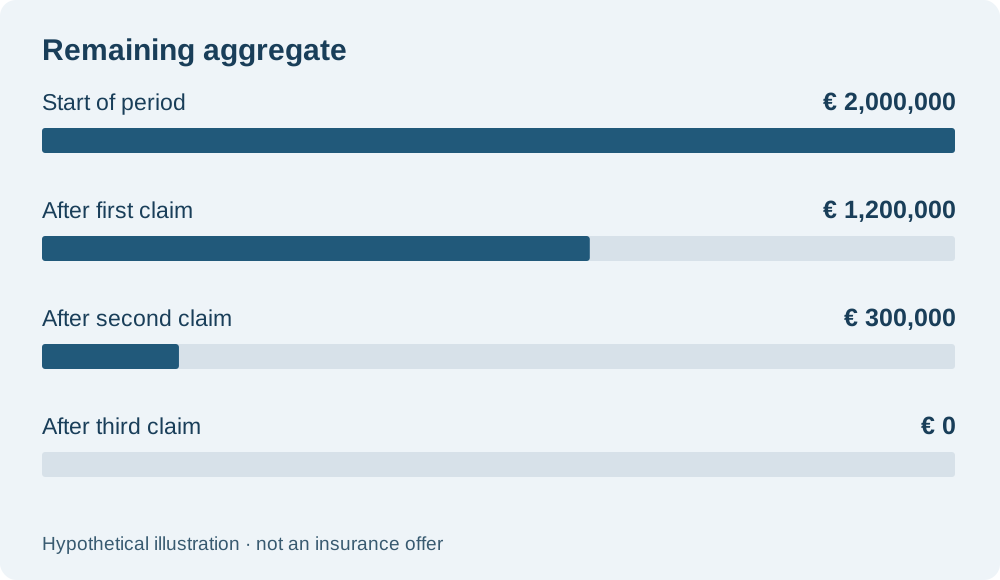
Assume a limit of EUR 1,000,000 per claim and a EUR 2,000,000 aggregate for the same period. Consider three separate, covered claims settled in sequence. To isolate the effect of the limits, this example disregards deductibles, excesses, sublimits, expenses and reinstatements.
A first payment of EUR 800,000 leaves EUR 1,200,000 in the aggregate. After a second payment of EUR 900,000, EUR 300,000 remains. A third loss of EUR 700,000 is below the per-claim limit, but the remaining aggregate allows only EUR 300,000. In this illustration, EUR 400,000 exceeds the available capacity.
These figures are for education only. They are not a quotation, an offered tariff combination or a promise of a BSA claim payment.
Sublimits and connected claims
An extension may have its own limit. In the wording cited here, article 2.10 states that a sublimit is included within the general limit rather than added to it. Before adding amounts shown in different parts of a proposal, check how the relevant covers interact.
Also review the connected-claims clause. Several claimants or demands do not necessarily create several separate limits. Definitions of a claim or a series of claims can affect how limits apply. This check is especially useful where several allegations arise from the same activity or omission.
A practical summary for the client
Record the following on one page: per-claim limit; aggregate and relevant period; sublimits; applicable deductible or excess; treatment of defence costs; and the rule for connected claims. Add the page or clause reference beside each item.
If a quotation omits any of these points, obtain the relevant wording or written clarification before presenting the comparison as complete. IVASS’s introductory guide explains coverage limits in general; the applicable contractual documents determine the position in a particular case.
The comparison becomes useful when the client understands both the capacity for one claim and the amount that could remain after several claims. This is a separate step from comparing premiums and checking insured activities.